
Video letters from childhood
Audiovisual correspondence between girls and boys from different indigenous and Afro-descendant territories.
If you are interested in responding to a video request, please contact us at comunicacion@redesac.org.mx
What are video letters?
The video letters are audiovisual productions in which children from indigenous and rural communities share their territory., history, identity, knowledge and culture from a personal and collective point of view.
This is a audiovisual correspondence which is created in a participatory manner where the children are the protagonists and who decide what to tell and how to tell it.
The process encourages expression, fun, trust, respect and collaborative work by the children. While they learn how to use the cameras and travel around the territory to create their audiovisual production, the children and adults involved recognize everything that makes their community unique.
In this dialogue, the children are also aware of the realities of children from other territories through their video letters, identifying similarities and differences in ways of life and fostering a diverse perspective of the world.
How do they arise?
Video letters were born in Cuba. Daniel Díaz Castrillo, filmmaker, journalist and founder of TV Serrana, in an article who, in 1993, had the idea of asking children from the eastern municipality of Pilón to tell children from the community of San Pablo Yao in the Sierra Maestra about their lives, their games and what their fathers and mothers did for a living. The excitement and happiness of seeing the realities of other children revealed the power of this format as a journalistic alternative to show and connect diverse realities, cultures, languages and stories.
From this experience, the production of video letters has expanded to countries such as Chile, Guatemala, United States, France, Spain, Peru, Ecuador, Nicaragua and Colombia.
In Mexico, the organization Ojo de Agua Comunicación began making these productions in 2012, connecting communities in different regions of the state of Oaxaca. During these years, they have delved deeper into themes that cross the lives of children, becoming a reference for those of us who have explored video art in subsequent years.
At REDES A.C. we began facilitating video letter workshops starting in 2021 in Creel and Mogótavo, in the Sierra Tarahumara of Chihuahua. This is thanks to the generosity of Guillermo Monteforte, one of the founders of Ojo de Agua Comunicación, who shared with us his learnings in the creation of videocartas, as well as Damián López, from whom we learned in a videocarta workshop in the Sierra-Costa of Michoacán in 2017.
So far, we have produced video-letters with children and youth from the Rarámuri people of Chihuahua, P'urhépecha of Michoacán, Wayuu of Colombia and Nahua of Michoacán and Puebla, as well as a radio-letter with Afro-Colombian youth.


Sample of video letters
Cherán K'eri sends his videocarta
REDES A.C. and Creative Seedbed of Cherán, 2024.
Pasipamana sends its videocarta
REDES A.C., Wayuu People's Communications Network and Shinyak Kashikay, 2024.
Videocoast from Kwéchi, Chihuahua
REDES A.C., Siné Comunarr, Community School of Kwéchi and Colectivo de Comunicaciones Montes de María Línea 21 de Colombia, 2023.
Videocoast from Tacuro, Michoacán
REDES A.C., Escuela Primaria General Ignacio Zaragoza and Chipi Films, 2023.
Videocarta from El Pasito
REDES A.C. and Red de Comunicaciones del Pueblo Wayuu, 2023.
An adventurous road: a video trail of the Ciénega de Norogachi, Chihuahua
REDES A.C. Montes de María Línea 21 Communications Collective, Siné Comunarr and Telesecundaria Porfirio Yáñez Barranco, 2023.
Radiocarta from San Onofre, Sucre, Colombia
REDES A.C. and Colectivo de Comunicaciones Montes de María, 2022.
Videorouting from Creel and Mogótavo, Chihuahua
REDES A.C., Siné Comunarr, Awé Tibúame A.C. and Comunidad Educativa Tamujé Iwigará A.C., 2022.
Videocoast from La Pista, Maicao, Colombia
REDES A.C. and the Wayuu People's Communications Network, 2022.
Videocarta of girls and boys of Huitzontla and El Tamarindo
REDES A.C., Red Solidaria de DH and Comité de Defensa de Tierra y Territorio de San Juan Huitzontla, Michoacán, 2017.
A video charter in your territory
Based on the progress in the realization of the video letters and the interest of other territories to replicate the process, we systematized the lessons learned and designed a methodological guide with recommendations and considerations for conducting a video letter making workshop, The company is aware that there is no single formula and that each process is different.
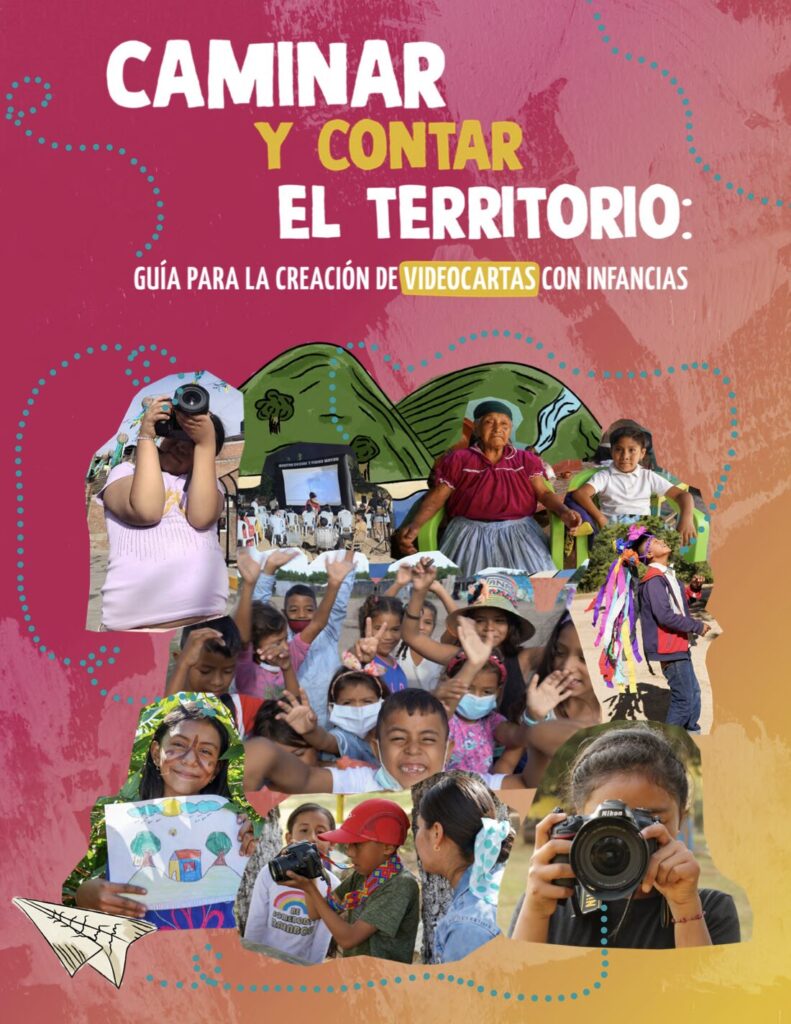
If you are interested in having us facilitate a video letter workshop in your community, would like to replicate the methodological guide or would like to screen the video letters that we have created at REDES A.C., please contact us at comunicacion@redesac.org.mx or through our social networks.
Experiences and lessons learned from the process
We share with you some of the experiences and lessons learned by those who have participated in our training workshops and accompanied the creation of the video letters.
- CESDER, where knowledge is sown - videocarta
- From March to May 2025, we taught a video-portrait workshop at the Center for Rural Development Studies (CESDER) in Zautla, Puebla. As a result, the students of the Specialty in Community Communication developed their own production to tell other young people what it is like to study at CESDER and to attract new students.
- “The word that is cultivated and travels in a video letter".
- Reflection written by Jaime Palma, Rarámuri community communicator from the community of Kwéchi, Chihuahua, and published in the ComunicarES blog.

See other video letters
We invite you to take a look at some of the other incredible videocartas produced in Mexico over the years:
Ojo de Agua Communication: Collection of video letters.
Roberto Olivares, in collaboration with Ambulante, Ojo de Agua Comunicación, La Calenda Audiovisual and the Traveling Audiovisual Camp (CAI): Let's go to the beach! (2014) y Children of the enchanted plain (2015).
Laboratory of Visual Anthropology (LAV) of the UAM-Iztapalapa (UAM-I): Videocast from La Dalia Market (2018) y Videocarta from the tracks (2021).
Daniel Ulacia: Greetings from Mercado La Merced (2015) y Mauro and the Zoo (2016).
Face to face: Video letters from Tabasco (2019).
Radio Tsinaka: Radiocartas made in the northern highlands of Puebla that have been sent to Venezuela and Palestine.
Talokan Mexico: Videocarta Feeling Tunnel 2, Tlatlauquitepec, Puebla (2024).
Tahtol-Palabra Collective: Videocarta from Tuzamapan-Xiloxochico (2024).
 English
  Español de México