Legal framework for community networks in Latin America
Regulation

International organizations specializing in telecommunications have pointed out the need to create regulatory frameworks to facilitate communication in underserved areas.
International organizations specializing in telecommunications have pointed out the need to create regulatory frameworks to facilitate communication in underserved areas.
Here you will find international recommendations and regulatory experiences regarding community networks, small operators and non-profit operators.
If you want to know more about this topic, you can consult the study Community Networks in Latin America: Challenges, Regulations and Solutions.
In addition, the APC, together with REDES and the Polytechnic University of Catalonia, has published the Policy and Regulatory Guidance for Enabling Local Operators.
The APC has developed the following wiki with information on regulatory examples to promote connectivity.
International Recommendations and Commitments
The international commitments that can be useful for the development of community networks have to do mainly with access to and affordability of information and communication technologies (ICTs), on the one hand, and strategies to achieve this goal, on the other.
Currently, there are, on the one hand, various instruments that define commitments at the regional or global level to achieve full connectivity under principles that make it possible to achieve full development and, on the other hand, specific strategies or actions that make it possible to achieve these commitments, in the form of recommendations and best practices.
The most important Recommendations and Commitments are:
The documents issued by the World Summit on the Information Society (WSIS)These emphasize the participation of multiple stakeholders in building the information society, especially civil society and indigenous peoples. Countries are obliged not only to allow, but also to encourage their participation in the construction of the information society, which makes explicit their agency in all issues related to it, from regulation, technological development, governance and network construction. Among them are:
- Declaration of Principles and the Action Plan of Geneva (2003).
- Other special mentions, for example in WSIS+10 y WSIS 2018 Results.
The Sustainable Development Goals of the United Nations OrganizationThese constitute a fifteen-year global agenda to reduce poverty, protect the planet, generate prosperity and promote peace. In this agenda, ICTs are considered indispensable for all seventeen goals, although they are specifically mentioned in goals 8 and 9 in relation to affordable universal coverage. Goal 5, Gender Equality, also establishes a specific ICT action Enhance the use of enabling technology, in particular information and communications technology, to promote women's empowerment.
The ITU Recommendation - D19 of the World Telecommunication Development Conference (WTDC) of the International Telecommunication Union (ITU), where modifications were made to the Recommendation during its 2014 edition, specifically related to community networks, which mentions, among them:
10. that it is important to take into account small, non-profit community-based operators by adopting appropriate regulatory measures to enable them to access basic infrastructure on equitable terms, in order to provide broadband connectivity to users in rural and remote areas and to take advantage of technological advances;
11. that it is also important that administrations, in their radio frequency spectrum planning and licensing activities, consider mechanisms to facilitate the provision of broadband services in rural and remote areas by small, non-profit community operators;
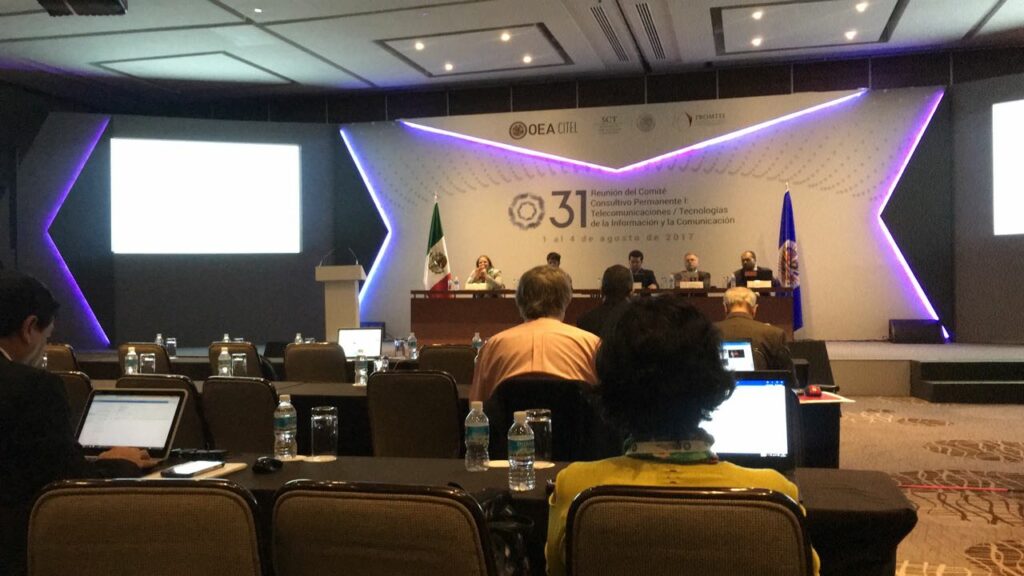
Resolution 268 of the Inter-American Telecommunication Commission (CITEL) which, based on the aforementioned Recommendation (ITU - D19), resolves to establish coordinated actions for the implementation of said recommendation, such as:
- Documentation, systematization and dissemination of experiences on the results of the implementation of the Recommendation.
- Support for the implementation of pilot projects (it is worth mentioning that ISOC has signed an agreement with CITEL for this purpose).
- Identification of appropriate spectrum regulatory aspects for the implementation of the recommendation.
- Support for the design of policies and regulations to achieve the objectives of this recommendation.
Thus, by considering these regulatory elements, community networks have a solid international legal basis on which to build local legislation.
Regulatory experiences in the Americas Region
The following database was obtained from a report prepared as part of the work of the Rapporteurship on Broadband for Universal Access and Social Inclusion of the Development Group of the Permanent Consultative Committee I (CCP1) of the Inter-American Telecommunication Commission (CITEL), in accordance with the mandate of Resolution CCP1-268, the Rapporteurship sent a questionnaire to the countries of the region to ascertain the status of implementation of Recommendation ITU-D 19 in the Americas, especially with regard to the creation of conditions that facilitate the development of small and community operators.
This work culminated in a report presented at the 33rd Meeting of the CICC-CITEL held in Washington in August 2018, entitled Report of the Rapporteurship Accompanying the Responses to the Questionnaire on the Implementation of Recommendation ITU-D 19 for the Americas Region and which is available at here.
Click on each country to learn about its regulatory landscape.
If you wish to contribute with information about regulation in the region or international commitments, please send us an email to comunicacion@redesac.org.mx
 English
  Español de México


