Technologies for Autonomy

This area seeks to strengthen the communication strategies and ways of life of rural and indigenous communities through appropriate Information and Communication Technologies (ICT). To this end, we accompany processes of appropriation, use and transformation of technologies based on participatory and co-design methodologies where people, media, organizations and communities reflect on their needs and dreams to decide what kind of technologies they require and how they will manage them.

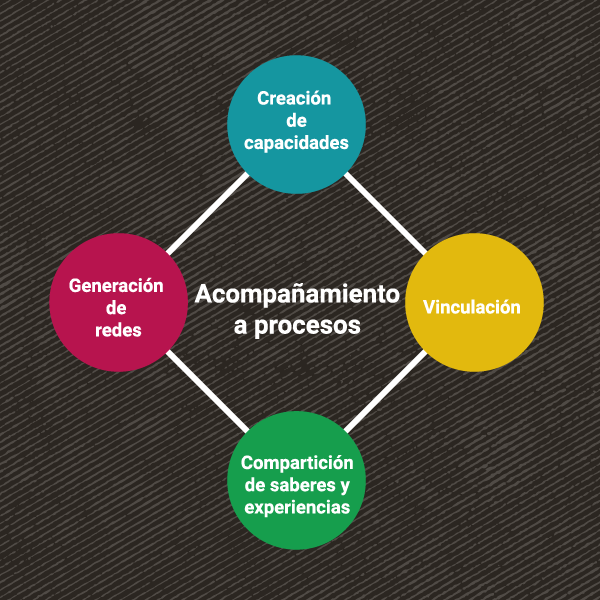
Our work has focused on accompanying processes developed by local organizations through capacity building, linking with key actors and generating networks for sharing knowledge and experiences. We do this in alliance with national and international organizations with which we create diverse strategies such as training programs, workshop facilitation, direct consultancy to projects and the creation and dissemination of pedagogical materials. 

Through these efforts we hope to contribute to collective processes that understand technologies as tools with which, from the community organization, to strengthen the knowledge, language, knowledge, memory, stories and territory of the communities and organizations with which we collaborate. 

Axes of
work

Training and capacity building

Promote and generate training processes that provide individuals, media, organizations and communities with the methodological, technical and organizational tools and capabilities for the installation, maintenance, management and sustainability of their projects for the autonomous use and appropriation of ICTs.

Meetings and articulation

Strengthen the technological autonomy initiatives that we support by promoting spaces for the exchange of experiences, fostering the creation of communities of practice and linking communities and organizations with key actors in academia, the technical community and the business and governmental sectors.

Infrastructure Co-Design and Deployment

Contribute to the collective design and implementation of projects for the deployment and maintenance of telecommunications infrastructure that respond to the needs, development objectives and dreams of the communities.

Sustainability

Systematize and generate spaces to share the different models of economic, organizational and community sustainability that allow the consolidation of experiences of autonomous use and appropriation of ICTs.
Projects

en_USEnglish

ICT Network Managers Training Program: Community Techio

In addition to providing technical knowledge for the installation, operation and maintenance of communication projects, this program, aimed at people belonging to indigenous and rural communities in Latin America, seeks to generate a network of people who accompany each other to strengthen the path towards technological autonomy in their territories.
It is the result of a collective effort of organizations linked to community and indigenous communication and the International Telecommunication Union (ITU). So far, it has two face-to-face editions in Mexico (between 2016 and 2019) and four Latin American generations, in which more than 200 people from 14 countries in the region have participated.

Beehive

Colmena is an open source toolbox for radio production and the creation of local and community content. This platform is a joint effort in partnership with DW Akademieand in collaboration with community media from Latin America and Africa for the production, communication, secure storage, dissemination and sharing of content. Colmena is a co-creation effort, which arises in the context of the Covid-19 pandemic, and which took its shape and name from a shared path of reflection and sharing around the emerging strategies of local media and the need to have their own tools for the continuity of their organizational processes and the strengthening of the territories.

Mobile Virtual Network Operators

Mobile Virtual Network Operators (MVNOs) provide mobile telephony services through the infrastructure of wholesale telecommunications companies. In Mexico, the Red Compartida-ALTAN is the one to which these MVNOs adhere in order to provide their services. Wiki Katat and Telecomunicaciones Indígenas Comunitarias - OMV (TIC-OMV) are the only MVNOs with social and community purposes in the country.

Through this project, it is possible to provide nationwide mobile telephony services that are more responsible and accessible to the economy of people living in indigenous and rural communities. As a non-commercial project, most of the income is distributed to create local content and strengthen the local economy of the indigenous communities, organizations, collectives and families that use the network.

Mobile Virtual Network Operators

Mobile Virtual Network Operators (MVNOs) provide mobile telephony services through the infrastructure of wholesale telecommunications companies. In Mexico, Altán La Red Compartida is the one to which these MVNOs adhere in order to provide their services. Wiki Katat and Telecomunicaciones Indígenas Comunitarias - OMV (TIC-OMV) are the only MVNOs with social and community purposes in the country.

Through this project, it is possible to provide nationwide mobile telephony services that are more responsible and accessible to the economy of people living in indigenous and rural communities. As a non-commercial project, most of the income is distributed to create local content and strengthen the local economy of the indigenous communities, organizations, collectives and families that use the network.

Learning Repository for Community Networks

This repository is a collective space for sharing, archiving and disseminating training resources (publications, audios, videos, guides, websites, among other materials) that help strengthen communication processes and access to telecommunications services in indigenous and rural communities. The initiative arises as part of the project Supporting Community-led Approaches to Addressing the Digital Dividecoordinated by the Association for Progressive Communications (APC) y Rhizomatica. It is financially supported by the Digital Access Programme (DAP) of FCDO of UK.

National Community Network Schools

The National Community Network Schools (NSCNs) are training processes aimed at building technical, organizational, social and sustainability capacities for the deployment and management of local solutions for meaningful access to telecommunications services for people in indigenous, rural or marginalized communities in the Global South.

Between 2020 and 2023, the first experiences of applying this model were developed in five countries: Brazil, Indonesia, Kenya, South Africa and Nigeria. These have been coordinated from within the framework of the project Supporting Community-led Approaches to Addressing the Digital Dividecoordinated by the Association for Progressive Communications (APC) y Rhizomatica. It is financially supported by the Digital Access Programme (DAP) of FCDO UK.

These are processes of technological appropriation for the benefit of communities where their ways of life, organization, memory, language, knowledge and skills are strengthened. From a critical reflection on the Internet and ICTs, we work to build technologies and digital environments that respond to the needs and dreams of those who use them. In this way, communities solve their connectivity problems and generate local strategies for meaningful access.

Currently, the initiatives we support in Mexico are: Radio Tosepan Limakxtum in the Sierra Norte de Puebla, Red Kwéchi in Chihuahua and Xamoneta in Cherán, Michoacán. Internationally, we accompany the development of the Jxa'h Wejxia Casil network in Pueblo Nuevo, Colombia.

Learn more about these processes here.