
Political Advocacy
This area works on the creation of national and international regulatory and public policy frameworks that enable the development of indigenous communication.
We start from the needs and aspirations of the communities, media and organizations, who identify the ideal scenario to which they aspire and the way to achieve it with or without the State, which has allowed us to generate an adequate regulatory framework in Mexico for both indigenous radio stations and community telecommunications networks.
The communities we accompany face various challenges such as exclusion, discrimination or extractivism when developing a communication project. We rely on the elements of a cycle of construction of legal alternatives to strengthen their efforts.
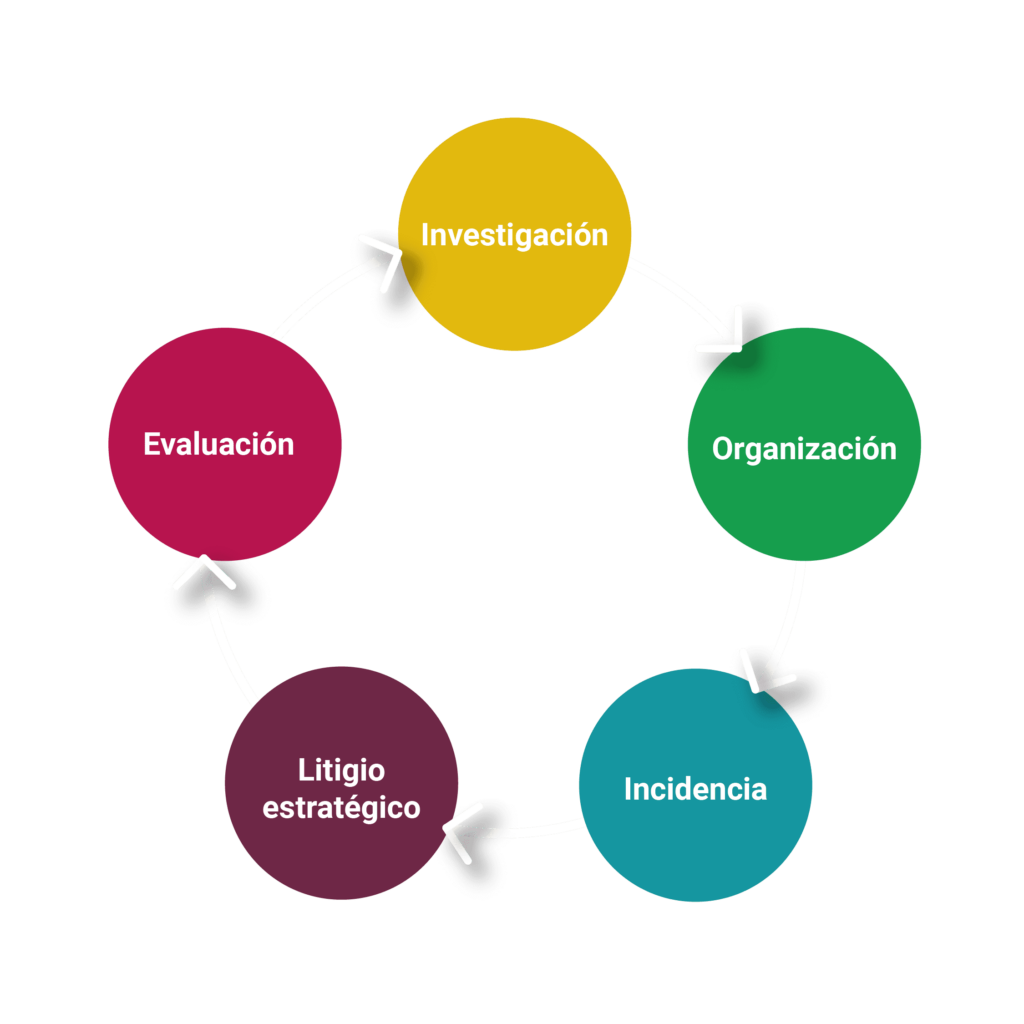
Axes of Work
We address two fundamental communication rights of indigenous peoples: 1) to generate conditions for them to acquire, manage and operate communication media and 2) to access non-indigenous media without discrimination.
We seek to eliminate barriers and create a favorable environment for the fulfillment of these rights. To this end, we focus on ensuring a regulatory and public policy framework favorable to the development of indigenous communication. With the birth of digital rights, we insert our long history of work in the field of communication rights into the transformation of the digital environment.
These transformation projects are the concrete manifestation of the rights of indigenous peoples to self-determination and of individuals to the free development of their personalities. In their implementation, they face multiple normative barriers that limit their realization and impede their recognition.
Therefore, we accompany communities in the creation of their communication projects, as a practical exercise of their rights to autonomy and self-determination. We identify barriers and transform them through advocacy on regulatory trends, negotiation with governments and international organizations, and strategic litigation.
Connectivity
Prevention
Defense
Transformation
Timeline
2009
- With ITU: Best practices ICT development in indigenous communities.
2012
- First cellular telephone network.
2013
- Constitutional reform in telecommunications.
2014
- Modification to WTDC Recommendation 19 for the recognition of community networks.
- Experimental concession for indigenous cellular telephony.
2015
- Bases for the regulatory development of indigenous communication in Mexico.
- The guidelines in which we participate for the granting of concessions are issued.
- General guidelines for the granting of concessions for indigenous social use.
2016
- Indigenous social concession guidelines.
- First concession of indigenous social use of telecommunications for community cellular telephony.
- #CommunicateIs campaign.
2018
- Access to the Mexican State's satellite reserve for indigenous telecommunications networks.
2019
- Reform to the Federal Law of Rights that eliminates the payment of radioelectric spectrum rights to indigenous telecommunications concessionaires.
2021
- Spectrum concession for point-to-point links.
- Ruling eliminating the tax credits for the payment of spectrum rights to Telecomunicaciones Indígenas Comunitarias AC.
2022
2023
- Confirmation of Criteria before the National Electoral Institute.
- Appeals filed by Radio Tosepan and Radio Cholollan Zacatepec against the amendments to the Electoral Radio and Television regulations without prior consultation.
- #OurRadiosOurStandards campaign.
 English
  Español de México