Since 2024, Radio Teocelo—Mexico’s oldest community radio station, with more than 60 years of service to the communities of Veracruz—and journalist Élfego Riveros Hernández have been facing legal proceedings that ostensibly sought to protect women’s rights, but which in reality became a mechanism of censorship.
The legal concept used was gender-based political violence (VPRG), a tool created to protect women who participate in political life. However, in this case, it was used to punish journalists and community media workers who published information of public interest regarding the family ties between a candidate for mayor of Teocelo, Veracruz, and a sitting official.
The legal harassment was not limited to Radio Teocelo. One lawsuit after another was filed.2 against more than 60 media outlets, organizations, and individuals who covered the events or expressed their solidarity: Boca de Polen, Ojo de Agua Comunicación, REDES A.C., EDUCA Oaxaca, La Coperacha, Canto de Cenzontles, and Radio Tsinaka, among others3. As a result, the case took on national significance and set a troubling precedent regarding the use of election law to limit freedom of expression within the community.
Where are we today?
By the end of 2025, the case had two outcomes that were in tension with one another.
A team victory. For the more than 50 media outlets, organizations, and individuals who were sued for showing solidarity with Radio Teocelo, the courts recognized that there was no gender-based political violence. The Xalapa Chamber of the TEPJF confirmed that their publications were protected by freedom of expression and the public interest.
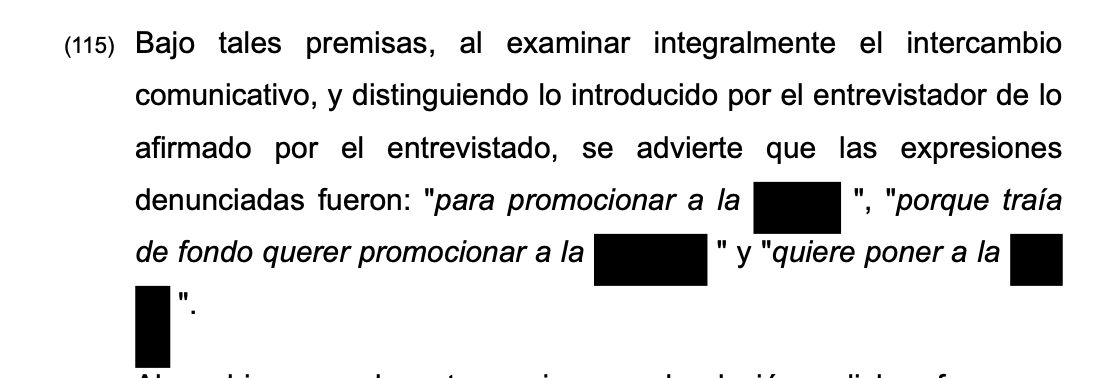
End of the siege of Élfego. The legal proceedings against Élfego Riveros Hernández continued for a few more months, but they too came to an end. On August 12, 2026, the Superior Chamber of the TEPJF ruled on the motion for reconsideration SUP-REC-619/2025: it overturned the rulings of the Xalapa Chamber and the Veracruz Electoral Tribunal, and declared that the alleged violation did not exist4.
The innovative approach
The Superior Court recognizes that sanctioning someone who works as a journalist for a community media outlet does not only affect that individual: it can have a deterrent effect on the very information that is most needed there, and it can stigmatize the station itself, damaging its credibility, its networks of community collaboration, and the functioning of its own collective dynamics.
This is the first time the Electoral Tribunal has acknowledged so clearly that A community broadcaster's freedom of expression has a social and collective dimension which goes beyond individual rights and therefore requires a distinct analysis. It is this criterion that makes the case a precedent with national implications for indigenous and community media.
Dissenting opinions in the Superior Court's ruling
The ruling was approved by a majority, with two dissenting opinions: Justices Reyes Rodríguez Mondragón and Mónica Aralí Soto Fregoso agreed that Élfego Riveros did not commit gender-based political violence, but they considered that the case should not have been opened through the extraordinary procedure of a motion for reconsideration.
Notes for this section (2, 3, and 4)
2. Special Sanctioning Proceedings CG/SE/PES/MYCV/453/2025 and its consolidated case, and CG/SE/PES/MYCV/582/2025 and its consolidated case, resolved by agreements CG/SE/CAMC/MYCV/123/2025 and CG/SE/CAMC/MYCV/150/2025, respectively, of the Complaints and Allegations Commission of the Local Electoral Authority of Veracruz; which we challenged as organizations in cases TEV-JDC-279/2025, TEV-JDC-281/2025, and TEV-JDC-280/2025 before the Electoral Tribunal of Veracruz, and subsequently in cases SX-JG-118/2025, SX-JG-114/2025, and SX-JG-116/2025, respectively, before the Xalapa Regional Chamber of the Federal Electoral Tribunal. ↩ Back
3. EDUCA Oaxaca. (November 25, 2025). Veracruz Court Once Again Convicts Community Journalists from Radio Teocelo for Political Gender-Based Violence. ↩ Back
4. Judgment rendered in Case No. SX-JDC-767/2025 by the Xalapa Regional Chamber of the Federal Electoral Court, overturned by Appeal for Reconsideration No. 619/2025, decided by the Superior Chamber of the Federal Electoral Tribunal on August 12, 2026, which found that the alleged offense of gender-based political violence attributed to Élfego Riveros Hernández did not exist. View Judgment SUP-REC-619/2025 (PDF). ↩ Back
 English
 Español de México